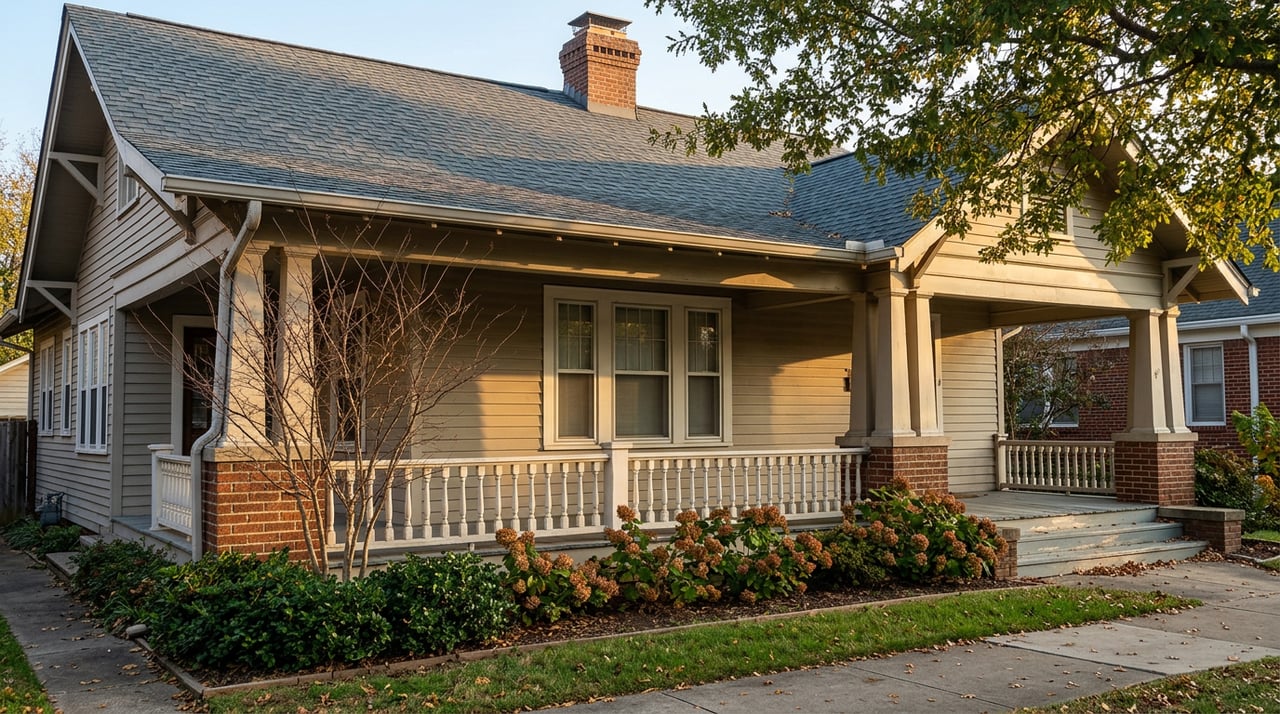
A VA appraiser and a preservation officer can look at the same porch railing and reach opposite conclusions. One is checking whether the house is safe to live in. The other is checking whether the railing looks like it belongs to 1910. Neither one answers to the other, and in Winston-Salem's West End, that gap between two separate approval processes is the thing most buyers never see coming until they're already under contract.
Here's the mechanism. If you're using a VA loan on a home built before 1978, the VA assumes any paint on that house is lead-based. Peeling or chipping paint has to be scraped and repainted or covered, full stop. Cost is never an accepted reason to skip it, and the VA appraiser has to certify the fix before your loan closes. That part is standard anywhere in the country.
West End is not anywhere in the country. It's a local Historic Overlay District, which means the exact same porch trim that the VA wants scraped and repainted also falls under review by Forsyth County's Historic Resources Commission, as the City of Winston-Salem explains. A paint case the Commission approved in October 2025 involved a homeowner repainting exterior woodwork and two outbuildings, and the record shows the final color, Sherwin Williams Emerald Urethane Trim Enamel in High Hide White, was chosen after consulting a historic preservation professional to confirm it matched the home's period.
So the same peeling paint that triggers a mandatory VA repair can also trigger a local approval process before you're allowed to touch it. If you don't know that going in, you can burn weeks discovering it mid-transaction.
Two Kinds of "Historic" Designation in West End
The confusion usually starts with a real estate listing that says the home is "historic" without specifying which kind. It matters more than most buyers realize. The West End Historic District carries a National Register listing, and a separate West End Historic Overlay District carries local zoning protection. They cover overlapping ground but work completely differently.
If a house is only on the National Register, the City of Winston-Salem explains that a private owner using private money can change the exterior without asking anyone. No review, no forms, no waiting for a meeting. But if that same house also sits inside the local Historic Overlay boundary, which most of West End does, the zoning ordinance takes over and any exterior change needs a Certificate of Appropriateness, or COA, before you can touch it.
Winston-Salem has had this kind of local oversight longer than any other city in the state. Its original historic district commission was created in 1948, the first in North Carolina, and Old Salem became the state's first local historic district as a result. Today that oversight lives with the Historic Resources Commission, formed in 2001, which administers Old Salem, Bethabara, and the West End Historic Overlay District as three separate but related zoning tools.
The practical takeaway for a buyer: don't assume a "historic" label means one thing. Ask specifically whether the property sits in the local overlay, because that's the designation that controls your renovation timeline, not the National Register plaque.
What Actually Needs a Certificate of Appropriateness
The Commission's own approval reports give a clear picture of how broad this net really is. Recent cases include:
- A new exterior electrical outlet for EV charging, mounted low and unobtrusively on a duplex, approved as routine Minor Work in an August 2026 report
- A Tesla Wall Charger installed at the rear of the W.B. Hawkins House, screened from street view, approved in a November 2025 report
- Nineteen solar panels installed flush with the rear roof of the Dr. Oscar P. Schaub House, alongside a roof shingle replacement, also approved in November 2025
- A full roof replacement on the Edgar D. Vaughn House using shingles designed to match the original historic profile, approved in October 2025
- A new pergola covering part of the rear deck at the James J. Norman House
- A battery backup power system at the Joseph E. Alexander House, with the only visible exterior components tucked at the rear foundation
- A wall-mounted mailbox, a dog door in a rear basement entrance, and a new window matching the historic six-over-six pattern, all reviewed as routine Minor Work between June and August 2026
Notice what's missing from that list: nothing dramatic. These are the ordinary repairs and upgrades any homeowner makes, and every single one of them went through a formal city review before it happened. If you're picturing historic district rules as something that only applies to additions and demolitions, the actual record shows otherwise. It applies to your mailbox.
One case worth flagging for anyone touring an older duplex or rowhouse in the district: a June 2026 report covered interior work, combining two small bathrooms and opening up a kitchen wall, because the project also touched historic fireplace surrounds and character-defining interior features. Most of the Commission's authority is about what you can see from the street, but that case is a reminder that the boundary between "exterior" and "reviewable" isn't always where you'd guess.
Two Review Timelines to Plan For
COA review follows different timelines, so it is worth accounting for the process before closing.
Small, routine items, the kind on the list above, get reviewed by Historic Resources staff and can be approved without waiting for a public meeting. That's the fast lane. It still requires a formal application, but it doesn't require the Commission's calendar to align with yours.
Bigger changes, new construction, additions, anything the staff can't sign off on alone, go to the full Commission, and applications for those are reviewed at the Commission's regular monthly meetings.
Applications go through the city's GeoCivix portal, which requires creating an account and submitting photographs and drawings in PDF format. The city is direct about the consequence of getting the paperwork wrong: incomplete documentation causes delays in processing. For a buyer trying to close on a VA timeline, that's not a footnote. That's the difference between a repair moving forward on schedule and a repair getting stuck behind next month's agenda.
What This Means Before You Write an Offer
If you're a veteran or first-time buyer looking at a home in West End, the smart move isn't to avoid the district. It's to ask the right question earlier than most buyers think to ask it.
Before you write an offer, find out whether the property sits inside the local Historic Overlay boundary, not just whether it has a historic reputation. If it does, and the home was built before 1978, walk the exterior with your agent looking specifically for peeling paint, deteriorating trim, and roof condition, the exact items the VA appraiser is required to flag. Anything that looks likely to trigger an MPR repair is also likely to need a Certificate of Appropriateness, and knowing that on day one means you can start the city application in parallel with your loan process instead of discovering it after the Notice of Value lands.
If you're the seller, the same logic runs the other way. A pending or unresolved COA on a repair you started and didn't finish is the kind of thing a buyer's agent will find, and it's better disclosed than discovered.
None of this makes West End a harder place to buy. It makes it a place where the calendar has one more moving part than most buyers expect, so planning ahead can help buyers account for the additional review timeline.
A Few Questions Worth Settling Early
Does a National Register listing by itself trigger a Certificate of Appropriateness? No. A National Register listing alone imposes no review requirement on a private owner using private funds. Review only applies inside a locally zoned Historic District or Historic Overlay District, which is a separate designation that happens to overlap with much of West End.
Does every repair need a full Commission hearing? No. Routine items like paint, EV chargers, and window swaps that meet the district's design standards are typically handled by Historic Resources staff as Minor Work, without waiting for the monthly meeting. Larger or more visible changes go to the full Commission.
If you're weighing a home in West End, Old Salem, or anywhere else in the Winston-Salem market and want a straight answer about what a specific property will actually require before you can call a repair finished, that's exactly the kind of question Melanie Pipes answers before you're locked into a contract, not after. Schedule a free consultation and bring the address.
This article is general information, not legal, tax or financial advice. Consult a qualified professional about your situation.